When growth adds legal entities, locations, products, transactions, and reporting demands, an accounting system can become a bottleneck. Teams may spend more time reconciling spreadsheets, moving data between applications, and explaining why reports disagree than analyzing performance.
D365 finance and operations is a common shorthand for Microsoft’s enterprise finance-and-operations applications. The current portfolio includes Dynamics 365 Finance for financial management and Dynamics 365 Supply Chain Management for operational processes. Together, these applications can connect the general ledger with purchasing, inventory, warehousing, manufacturing, planning, and related workflows. This guide explains the Finance & Operations terminology, capabilities, business fit, and implementation decisions behind more connected finance and operations management.
Key Takeaways
- D365 F&O is not a single out-of-the-box answer to every growth problem. Buyers should start with business requirements and select the applications and capabilities that match them.
- Dynamics 365 Finance covers areas such as general ledger, accounts payable, accounts receivable, budgeting, cash and bank management, fixed assets, tax, consolidation, and financial reporting.
- Dynamics 365 Supply Chain Management adds operational capabilities across procurement, inventory, warehousing, planning, production, and asset management.
- Business fit depends more on process and reporting complexity than on revenue or employee count alone.
- Implementation requires process design, data migration, integration, security, testing, training, cutover, and continuous improvement - not just software configuration.
What Is Dynamics 365 Finance and Operations?
Dynamics 365 for finance and operations is a market term often used for Microsoft’s enterprise resource planning (ERP) applications that share a finance-and-operations platform. An ERP system creates a structured environment for recording transactions, applying controls, and coordinating processes across departments.
Microsoft’s current documentation presents Dynamics 365 Finance and Dynamics 365 Supply Chain Management as distinct applications. Finance is the financial core. Supply Chain Management supports operational processes that can create financial impact, such as purchasing, inventory movement, production, and fulfillment. A company may license and implement the applications it needs, subject to Microsoft’s current licensing terms and the solution design.
That distinction matters. A buyer searching for Dynamics 365 F&O should not assume that every module, integration, analytics feature, or industry requirement is included in one license or enabled by default. Capabilities can depend on the licensed application, configuration, geography, release, security role, add-on, and third-party solution.
Microsoft Learn: finance and operations application documentation
What Are the Core D365 Finance and Operations Modules?
The practical value is not having more ERP modules. It is reducing the gaps between financial and operational processes. For a growing company, that can mean fewer manual reconciliations, more consistent reporting, clearer process ownership, and better visibility across entities and operations.
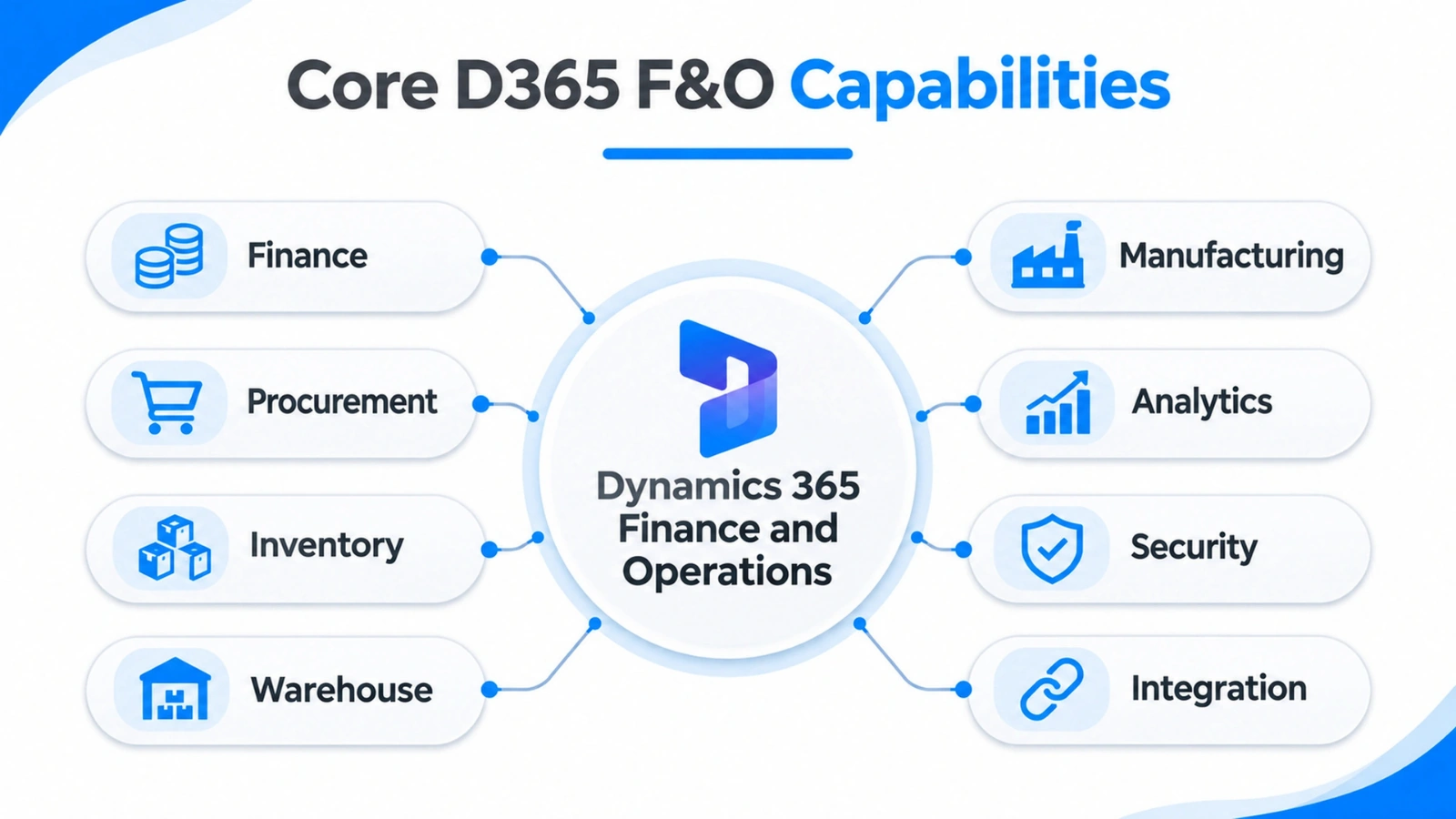
The following map connects major application areas with the business problems they can address. It is a capability guide, not a statement that every company needs every module.
| Capability area | Examples of documented capabilities | Business questions it can help address |
|---|---|---|
| Financial management | General ledger, accounts payable, accounts receivable, cash and bank management, budgeting, fixed assets, tax, credit and collections | Can finance standardize transaction processing, improve control, and reduce manual reconciliations? |
| Financial reporting and consolidation | Dimension-based reporting, statements, consolidation options, eliminations, currency translation, drill-down | Can leaders report across legal entities, accounts, dimensions, and currencies without rebuilding the same spreadsheet pack? |
| Procurement and sourcing | Vendors, purchase requisitions and orders, sourcing, receiving, invoice-related processes | Can purchasing follow defined approvals and connect commitments, receipts, and liabilities? |
| Inventory and warehouse management | Item and inventory processes, locations, inbound and outbound work, replenishment, mobile warehouse processes | Can teams see stock and movement consistently across facilities and link operations to financial outcomes? |
| Planning and manufacturing | Master planning, production control, bills of materials, routes, shop-floor processes | Can the business plan supply and production with common data rather than disconnected schedules? |
| Asset management | Asset maintenance planning and execution for operational assets | Can maintenance teams coordinate work while preserving relevant cost and operational information? |
| Platform, analytics, and integration | Role-based access, workflow automation, reporting and analytics, and integration options for connecting Dynamics 365 with other business systems | Can the solution exchange information with CRM, analytics, ecommerce, banking, tax, and other systems under a governed architecture? |
Microsoft’s documentation should be checked against the exact requirements and licensing plan during solution design.
Dynamics 365 Finance documentation
Dynamics 365 Supply Chain Management documentation
What Can D365 F&O Do for a Growing Business?
Consider a growing distributor operating several US legal entities. Finance may currently consolidate entity-level results in spreadsheets while warehouse, purchasing, and sales information sit in separate applications. An F&O evaluation would examine whether those processes can move into a more coordinated operating model, how intercompany activity should be handled, what reporting dimensions leadership needs, and which integrations should remain outside the ERP.
Create a more consistent financial core
Dynamics 365 Finance can bring core accounting, payables, receivables, cash, budgets, fixed assets, tax configuration, and reporting into a governed application. The value is not simply storing more transactions. It is establishing common account structures, dimensions, approval rules, posting logic, close activities, and ownership.
Support multi-entity reporting
Microsoft documents several approaches to consolidation, including online consolidation, financial reporting, and imported balances. Financial reporting can combine transactions and balances, support reporting hierarchies, and present multiple reporting currencies. The right method depends on ownership structures, charts of accounts, currencies, elimination requirements, and source systems. Microsoft Learn: consolidation and elimination overview
For a US group adding subsidiaries, the practical goal may be a repeatable month-end process: each legal entity closes under defined rules, intercompany activity is identified, eliminations are controlled, and leadership receives a consolidated view with traceable detail.
Connect finance with operations
When purchasing, inventory, warehouse, and production activity sits outside finance, teams often reconcile operational records to the ledger after the fact. A connected ERP design can carry the financial consequences of approved operational transactions into a common control framework. This does not eliminate process decisions; it makes those decisions explicit in system design.
Strengthen access and process controls
Finance and operations apps use role-based security. Microsoft describes roles, duties, privileges, and permissions as a hierarchy aligned with business responsibilities. The platform also supports segregation-of-duties rules. These capabilities still require deliberate design, testing, approval, and periodic review.
Microsoft Learn: role-based security
Who Should Consider Dynamics 365 Finance and Operations?
A company should consider D365 F&O when its requirements resemble enterprise ERP complexity, even if it is still described as mid-market. Relevant signals include:
- Multiple legal entities, currencies, charts of accounts, or consolidation paths.
- Distribution, manufacturing, warehousing, or asset-intensive processes that must connect with finance.
- High transaction volumes or close processes that strain the current system.
- A need for stronger approvals, role design, auditability, or segregation of duties.
- Reporting that must combine financial and operational dimensions.
- A growing integration landscape involving CRM, ecommerce, payroll, banks, tax tools, data platforms, or specialized applications.
- Leadership sponsorship and a team able to make process, data, and change decisions.
D365 F&O may be more than a company needs when requirements remain accounting-led, operating processes are straightforward, and existing systems produce dependable results without excessive manual effort. Microsoft Dynamics 365 Business Central or improvements to the current environment may also deserve evaluation. Product fit should follow a requirements comparison, not a predetermined platform choice.
Signs Your Business Has Outgrown Its Current Systems
Common warning signs are recurring, cross-functional, and costly, not merely inconvenient.
- The close depends on repeated spreadsheet consolidation and manual journal preparation.
- Customer, vendor, item, or account data is duplicated across systems with no clear owner.
- Finance cannot trace reported results to operational activity without manual investigation.
- New entities or locations require copied processes and separate reporting workbooks.
- Inventory availability differs between sales, warehouse, and finance teams.
- Integration failures are corrected manually, with limited monitoring or accountability.
- Security access has accumulated over time and no longer reflects job responsibilities.
- Growth initiatives are delayed because the current architecture cannot support the target operating model.
One isolated issue may call for a focused fix. The case for ERP becomes stronger when the same data, control, and visibility problems appear across several processes.
What Does a D365 Finance and Operations Implementation Involve?
A sound implementation treats the ERP as a business transformation program. Microsoft recommends its Success by Design guidance as an adjunct to the project team’s chosen implementation methodology. The work commonly includes:
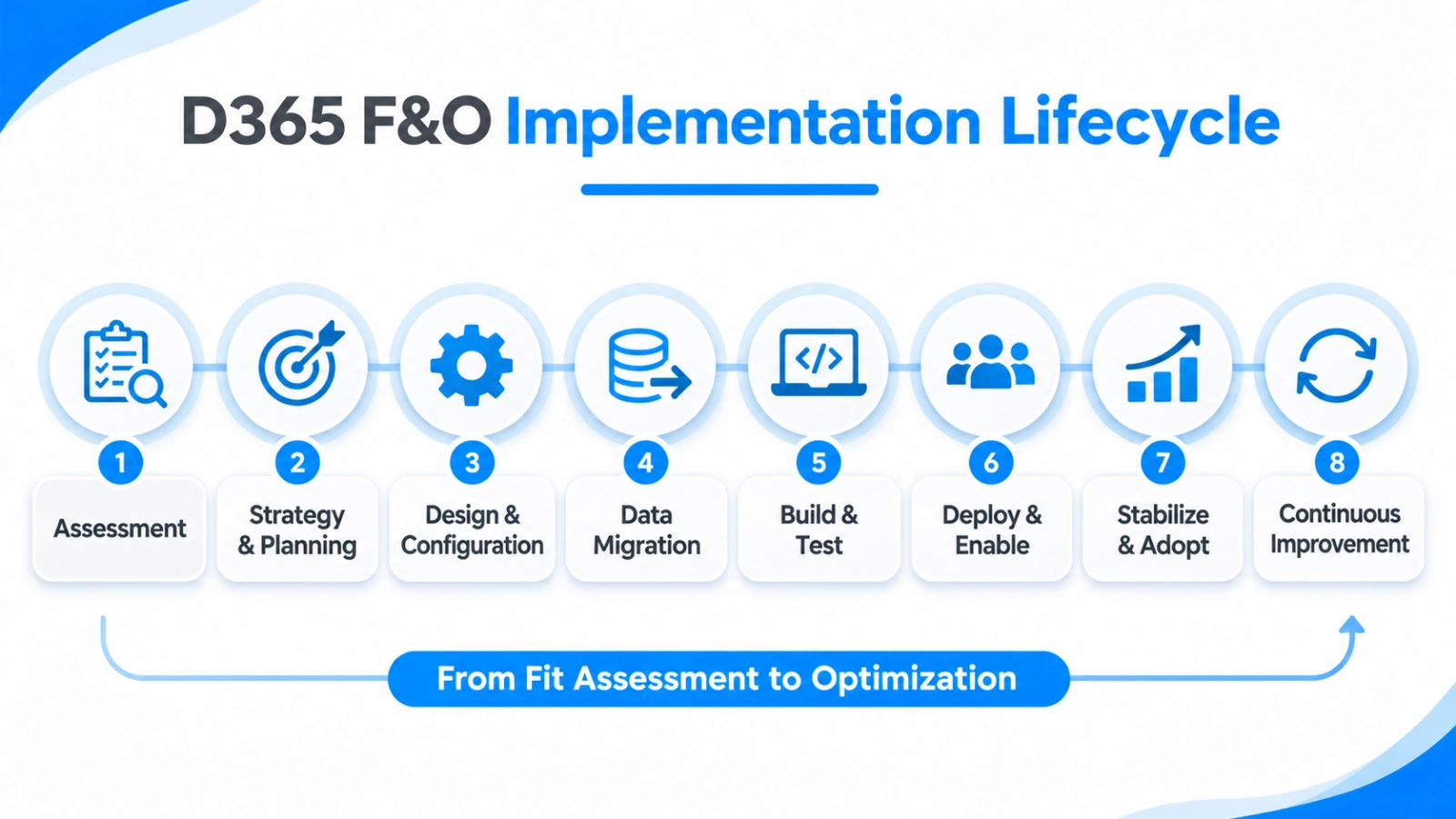
- Fit assessment and business case: Define problems, outcomes, scope boundaries, decision criteria, sponsorship, and measurable success indicators.
- Process discovery and solution blueprint: Map current and future processes, legal entities, reporting structures, controls, roles, integrations, and exceptions. Identify where standard capabilities fit and where a justified extension may be required.
- Architecture and environment planning: Design the application landscape, security model, integration patterns, data strategy, reporting approach, and environment plan.
- Configuration and controlled extension: Configure applications against approved process designs. Keep custom development purposeful and supportable.
- Data migration: Profile, cleanse, map, transform, load, and reconcile configuration, master, open, and historical data. Microsoft distinguishes configuration data from migration data; both need owners and acceptance rules. Microsoft Learn: data migration for Dynamics 365 projects
- Integration and reporting: Build and test required interfaces, error handling, monitoring, financial statements, management reports, and analytics. Dual-write can provide bidirectional, near-real-time integration between finance and operations apps and Dataverse for supported scenarios, but it is one option within a broader integration design. Microsoft Learn: dual-write overview
- Testing, training, and cutover: Run unit, system, integration, security, performance, user-acceptance, migration, and cutover tests appropriate to scope. Prepare users for redesigned processes, not only screen navigation.
- Deployment and improvement: Stabilize operations, resolve issues through governance, monitor adoption and controls, and prioritize improvements after go-live.
No credible timeline or budget can be inferred from the product name alone. Scope, legal entities, countries, data quality, integrations, extensions, reporting, testing, and organizational readiness materially affect the plan.
What Should US Companies Consider Before Implementing D365 F&O?
Multi-entity reporting and US GAAP
The FASB Accounting Standards Codification is the official source of authoritative nongovernmental US GAAP. Dynamics 365 Finance can support configured accounting structures, dimensions, periods, controls, and financial reporting, but implementing the software does not make a company GAAP-compliant by itself. Finance leadership and qualified accounting advisers still need to define the company’s accounting policies, chart of accounts, recognition rules, consolidation approach, close controls, and financial statement requirements.
FASB: Accounting Standards Codification
Multi-state sales tax
Dynamics 365 Finance documents sales-tax codes, groups, authorities, settlement periods, posting groups, calculation, and reporting processes. Those features require accurate configuration and maintenance. A company must still determine where it has registration and collection obligations, which products or services are taxable, which exemptions apply, and how rates and rules will be maintained. A tax engine or specialist provider may be part of the architecture; that need should be assessed rather than assumed.
Microsoft Learn: sales tax overview
Data, integrations, and reporting
Decide which historical data belongs in the ERP, which can remain in an accessible archive, and how opening balances and open transactions will be reconciled. Inventory, customer, vendor, and product data need accountable owners. Each integration should have a defined system of record, frequency, security method, failure process, monitoring owner, and recovery procedure.
Security and adoption
Translate job responsibilities into roles and test them with realistic scenarios. Review segregation-of-duties conflicts and sensitive data access before go-live. At the same time, involve process owners early, train by role, publish support routes, and measure whether people are following the future process.
How to Choose the Right Dynamics 365 Implementation Partner
An implementation partner should help the business make defensible decisions, not simply reproduce every legacy process. Evaluate partners on:
- Finance and operational process expertise relevant to the proposed scope.
- A requirements-led method that connects business outcomes to solution design.
- Experience with legal entities, reporting, tax architecture, security, integrations, migration, testing, and cutover.
- A clear approach to standard configuration, extensions, and technical debt.
- Defined governance, roles, deliverables, quality gates, escalation, and knowledge transfer.
- Training, change, stabilization, and support options that match internal capability.
- References and proof that can be verified for comparable work.
Is Dynamics 365 Finance and Operations Right for Your Business?
Use a fit assessment to answer five questions:
- Which business outcomes are blocked by the current environment?
- Which finance and operational processes need to be connected or controlled differently?
- Which legal entities, users, reports, integrations, data, and regulatory requirements are in scope?
- Is the organization prepared to assign decision-makers, process owners, data owners, subject-matter experts, and change capacity?
- Do the expected benefits justify the licensing, implementation, operating, and change costs?
A strong decision can be to implement D365 F&O, select a narrower Dynamics 365 application footprint, phase the program, evaluate another ERP, or improve the current environment. The goal is fit, not platform adoption for its own sake.
Frequently Asked Questions
Is Dynamics 365 F&O the same as Dynamics 365 Finance?
Not exactly. D365 F&O is commonly used as an umbrella term for Microsoft’s finance-and-operations applications. Dynamics 365 Finance is the financial management application; Dynamics 365 Supply Chain Management covers many operational capabilities. Confirm the exact application and license scope during evaluation.
What business problems can D365 Finance solve?
Dynamics 365 Finance can support structured general ledger, payables, receivables, cash and bank, budgeting, fixed assets, tax, credit and collections, consolidation, and financial reporting processes. The value depends on how those capabilities are configured around the company’s policies, data, controls, and reporting needs.
Does Dynamics 365 Finance support multiple companies?
Microsoft documents legal-entity, intercompany, consolidation, elimination, currency-translation, and multi-company reporting options. The appropriate design depends on the ownership structure, source systems, charts of accounts, currencies, and reporting requirements.
Can D365 F&O integrate with CRM and Power BI?
Finance and operations apps provide several integration and analytics options. Microsoft documents Power BI integration, data entities, business events, and dual-write with Dataverse. The correct pattern depends on latency, volume, ownership, security, and support requirements; licensing and configuration should be confirmed.
How long does a D365 F&O implementation take?
There is no responsible standard answer. Duration depends on scope, entities, countries, processes, data, integrations, extensions, reports, testing, decision speed, and organizational readiness. A fit assessment and discovery phase should establish a defensible plan.
Is D365 F&O suitable only for large enterprises?
No single company-size threshold determines fit. A growing mid-market company may justify enterprise ERP when it has multi-entity reporting, complex supply chain or manufacturing processes, high transaction volumes, demanding controls, or a broad integration landscape. Simpler requirements may be better served by a smaller platform or the current system.
Start With Fit, Not Features
D365 finance and operations can provide a connected foundation for complex financial and operational management, but the platform creates value only when scope, process, data, controls, integration, and adoption are designed together. Buyers should define the problems they need to solve, compare the required application footprint with credible alternatives, and test organizational readiness before committing.
The goal is not to adopt the largest ERP available. It is to determine whether the platform fits the complexity the business needs to manage now and next.
Book an F&O Fit Assessment
Not sure whether Dynamics 365 Finance and Operations fits your current complexity and growth plans?
A structured fit assessment can help clarify your financial and operational requirements, application scope, data and integration dependencies, organizational readiness, and the decisions that should be resolved before implementation planning begins.
Primary Sources
- Microsoft Learn: What is the Dynamics 365 implementation guide?
- Microsoft Learn: Introduction to Success by Design
- Microsoft Learn: Dynamics 365 Finance documentation
- Microsoft Learn: Dynamics 365 Supply Chain Management documentation
- Microsoft Learn: Finance home page and financial management areas
- Microsoft Learn: Supply Chain Management overview and functional areas
- Microsoft Learn: Financial dimensions
- Microsoft Learn: Financial consolidations and currency translation overview
- Microsoft Learn: Set up sales tax codes
- Microsoft Learn: Plan your chart of accounts